


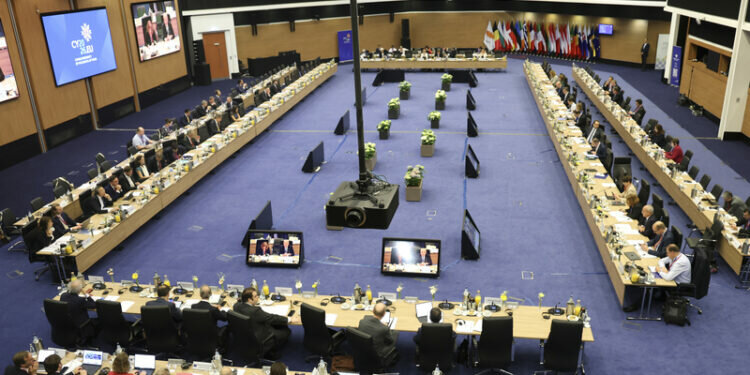
BRUSKA / NICOSIA – A fragile optimism, balanced against the persistent uncertainties of the global geopolitical landscape, defined the mood in Cyprus. Confronted by the energy market shocks rippling from the conflict in Iran, the European Union finds itself navigating a delicate equilibrium: a sense of relief that macroeconomic data has averted a severe downturn, contrasted with the lingering shadow of a protracted systemic shock. The informal Eurogroup summit convened on May 22 thus served as a barometer for a Union operating at two emotional speeds, caught between reassuring technical metrics and the political anxieties of national governments.
The deliberations of the Eurozone finance ministers opened against the backdrop of the European Commission’s latest economic forecasts. While the data delineates an economic expansion that is admittedly anaemic, it remains safely in positive territory. Yet, this underlying resilience has proved insufficient to fully reassure northern member states. Lithuanian Finance Minister Kristupas Vaitiekunas voiced these deeper concerns, noting: “I am concerned. In April, inflation in Lithuania reached 5.1 per cent.” For Vaitiekunas, the macroeconomic diagnosis is clear: “Low growth paired with high inflation represents the most challenging economic matrix possible. We face a defining policy crossroads: supporting economic growth or securing price stability.”

The Energy Vector and the ECB’s Equation
The true undercurrent of the Cypriot summit remained the future trajectory of monetary policy—a dossier debated behind closed doors in the presence of European Central Bank President Christine Lagarde. The Frankfurt chief did not downplay the gravity of the current landscape, though she firmly defended the anchoring of long-term inflationary expectations around the structural 2 per cent target.
“The energy shock is serious, generating both direct and indirect effects across our economy,” Lagarde acknowledged during the concluding press conference. Looking beyond an eventual cessation of hostilities in the Middle East, she added: “Even if the war were to end today, its repercussions would endure for a considerable period. Restoring pre-war conditions requires, first and foremost, rebuilding shattered infrastructure.”
Regarding the critical Governing Council meeting on June 11—where the central bank must decide whether to tighten interest rates further—Lagarde maintained a posture of strict prudence, adhering to the established mantra: “We will continue to be entirely data-dependent.”
Systemic Risks Versus Technical Resilience
Eurogroup President Kyriakos Pierrakakis provided a structured assessment of this complex transition. While emphasizing that the Eurozone continues to demonstrate a robust capacity to absorb external shocks, Pierrakakis cautioned that “pressure is intensifying across strategic nodes such as energy and fertilizers, which are vital components for our agrarian and industrial supply chains.” It was a measured warning highlighting the ongoing risk of localized supply bottlenecks.
Amid these widespread anxieties, a more reassuring note was struck by Pierre Gramegna, the Managing Director of the European Stability Mechanism (ESM). In an effort to stabilize market sentiment and reinforce confidence among European partners, Gramegna rejected the more pessimistic economic labels. “As things stand, there are simply no grounds to speak of either stagflation or recession,” he stated.
This technical appraisal ultimately offers a solid anchor of stability for a Eurozone navigating the fluid macroeconomic crosscurrents of the Middle Eastern crisis.
Associated Correspondents @europolitiche.it*
This text is a think tank note and is not a journalistic article
BRUXELLES – Un ottimismo fragile, costantemente alle prese con le incertezze del quadro geopolitico globale. L’Unione Europea, stretta nella morsa della crisi energetica innescata dal conflitto in Iran, si scopre vulnerabile tra il sollievo per dati macroeconomici che evitano il tracollo e l’ombra di uno shock sistemico prolungato. L’Eurogruppo informale riunito il 22 maggio a Cipro è diventato così il termometro di un’Unione europea a due velocità emotive: da un lato le rassicurazioni tecniche, dall'altro l'allarme politico dei governi.
I lavori dei ministri delle Finanze dell'eurozona si sono aperti sul crinale scivoloso delle ultime previsioni economiche della Commissione UE. I numeri descrivono una crescita anemica ma ancora in territorio positivo, una resilienza che però non basta a tranquillizzare i ministri degli Stati membri nord-europei. È il ministro delle Finanze lituano, Kristupas Vaitiekunas, a dare voce ai timori più profondi: «Sono preoccupato. Ad aprile in Lituania l'inflazione ha toccato il 5,1 per cento». Per Vaitiekunas la diagnosi è netta e priva di sconti: «Bassa crescita e alta inflazione rappresentano la peggiore combinazione economica possibile. Ci troviamo davanti a un bivio drammatico: stimolare lo sviluppo o blindare la stabilità dei prezzi».
Il fattore energia e l'equazione della BCE
Il vero convitato di pietra del vertice cipriota resta la traiettoria della politica monetaria, un dossier discusso a porte chiuse alla presenza della presidente della BCE, Christine Lagarde. La numero uno di Francoforte non ha nascosto la gravità della situazione, pur rivendicando la tenuta delle aspettative di lungo periodo, ancora ancorate all’obiettivo del 2 per cento.
«Lo shock energetico è serio e genera effetti diretti e indiretti sulla nostra economia», ha ammesso Lagarde in conferenza stampa, gettando uno sguardo oltre la fine delle ostilità in Medio Oriente: «Anche se la guerra dovesse finire oggi, gli strascichi continuerebbero a farsi sentire a lungo. Ricreare le condizioni antecedenti al conflitto significa innanzitutto ricostruire le infrastrutture distrutte».
Resta l'enigma sul consiglio direttivo dell’11 giugno, l'appuntamento cruciale in cui la BCE dovrà decidere se procedere a una nuova stretta sui tassi d’interesse. Sul punto, Lagarde ha scelto la linea della massima prudenza, blindandosi dietro il consueto mantra: «Continueremo a dipendere esclusivamente dai dati».
Tra rischi reali e frenate psicologiche
A delineare un quadro di complessa transizione è stato anche il presidente dell’Eurogruppo, Kyriakos Pierrakakis. Sebbene l'Eurozona stia dimostrando di saper reggere l'urto, Pierrakakis ha avvertito che «la pressione si sta intensificando su nodi strategici come l’energia e i fertilizzanti, asset vitali per la nostra catena agricola e industriale». Un campanello d'allarme che evoca, senza citarlo apertamente, il rischio concreto di un blocco produttivo.
In questo scenario di diffusa apprensione, il ruolo del pompiere è stato assunto dal direttore esecutivo del Meccanismo Europeo di Stabilità (MES), Pierre Gramegna. Nel tentativo di rasserenare i mercati e i partner europei, Gramegna ha respinto le definizioni più cupe: «Allo stato attuale, non ci sono le condizioni per parlare né di stagflazione né di recessione».
Una valutazione tecnica che si trasforma nell'unico vero appiglio di fiducia per un'eurozona orfana di certezze, costretta a navigare a vista nel mare aperto della crisi mediorientale.
inviati associati @europolitiche.it*
This text is a think tank note and is not a journalistic article - Questo testo è una nota del think tank* e non è un articolo giornalistico