



EU/ENG - David Abulafia did not merely recount the history of a sea for years; he made us intellectually inhabit his Mediterranean. Personally, Abulafia acknowledged himself as a lover of this intricate expanse of the world—an enduring devotion that has led him to explore, to question, and to write throughout his life, striving to give back something that this sea still jealously guards. Across all his writings, in his lectures, and in every interview granted, the Mediterranean appears and persists as an active participant rather than a mere object of academic study: the sea is alive, untamed, and plied by men perpetually in motion since the dawn of time. For Abulafia, the Mediterranean is fundamentally a singular entity: a history woven from encounters, exchanges, and conflicts—never an island, but an archipelago of peoples.
This conviction profoundly permeates his writings along a coherent trajectory that begins with the celebrated The Western Mediterranean Kingdoms, 1200–1500 (Laterza, 1999) (pictured below) and extends to his most recent works. Yet it is precisely in this book that Abulafia overtly reveals his deepest and most intellectual affection for the Mediterranean, choosing to portray it not as an analyzable phenomenon, but as an intimately human saga. Through his words, we have witnessed a living sea, managed by various civilizations but never truly dominated—a space shaped by merchants, navigators, kings, emperors, pilgrims, slaves, and travelers. From a historiographical standpoint, this evinces a remarkably clear analytical intent.
Abulafia engages in a continuous dialogue with his masters and predecessors, grounding his thought in the work of Fernand Braudel. Alongside him, he reasserts the human identity of Mediterranean history, preceding its purely geographical definition, while deeply investigating the social and economic causes and consequences driven by centuries of human phenomena.
Abulafia speaks to us of a sea that unites rather than divides. He perceives not an untarnished surface, but an unstable foundation for millennia-old socio-cultural structures—a hybrid, communicative space that connects, refusing to let things settle before preparing to change anew. This conviction runs through all the historical contexts he has studied: from the Middle Ages and the maritime republics to the Sicily of Frederick II and the Spain of the Reconquista. The Mediterranean we encounter, for instance, in his The Great Sea: A Human History of the Mediterranean (Mondadori, 2013) (pictured below) is a dense web of relations where identities, languages, and civilizations touch and mingle, finding their definition in exchange rather than in purity. What is presented to us is a world of continuous and constant cross-pollination that renders any national or monolithic narrative utterly obsolete.
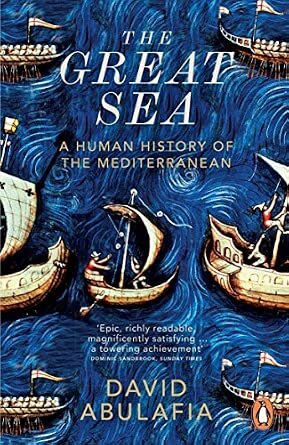
It is no coincidence that Abulafia appears so attentive to the narratives of minorities, diasporas, and merchant routes. From his own family background, tied to the Sephardic world and the memory of the expulsion from Spain, one can discern his profound human sensitivity to stories of forced migration and the reconstruction of identity. In his vision as a historian, he studies the Mediterranean as a realm defined by movement and plurality. When he subsequently wrote The Boundless Sea: A Human History of the Oceans (Feltrinelli, 2019)—choosing to address maritime history on a global scale—he was not betraying the Mediterranean; rather, he was observing it from a broader perspective. He demonstrated once more that it was upon this very sea that humanity first expressed itself and matured until it conquered the world. Here, where the first steps were taken upon a liquid, unstable, and unknown surface, man discovered himself for the first time in history to be both an explorer and a dreamer.
This is the legacy David Abulafia has left us: a magnificent chronicle woven of men, ideals, and the sea. A sea that has never belonged to anyone, and that no one has ever managed to reduce to a static definition, but which we can only perceive in motion, shaped by exchange and shared endeavor.
In a present day where the Mediterranean seems persistently portrayed as a border and a barrier, the memory of figures like David Abulafia is both right and essential—reminding us that, above all else, the sea is a place of possibility.
Ernesto Ciampi for @europolitiche.it

EU/ITA - David Abulafia non ci ha raccontato per anni la storia di un mare, ci ha fatto abitare intellettualmente il suo Mediterraneo. In prima persona Abulafia si è riconosciuto amante di questo intricato spazio di mondo, un amore durato nel tempo e che lo ha portato ad esplorare, ad interrogarsi e a scrivere per tutta la vita, cercando di restituire indietro qualcosa che questo mare ancora custodisce gelosamente. In tutti i suoi scritti, nelle sue lezioni, in ogni intervista concessa, il Mediterraneo compare e permane come un attore presente e mai come un mero oggetto di studio accademico: il mare è vivo, è incontrollabile ed è solcato da uomini costantemente in viaggio dall’alba dei tempi. Per Abulafia, il Mediterrraneo è sostanzialmente una cosa sola: una storia fatta di incontri, scambi e conflitti, mai un'isola, ma un arcipelago di popoli.
Questo pensiero pervade profondamente i suoi scritti, in una linea coerente che parte dal celebre “I regni del Mediterraneo occidentale dal 1200 al 1500” (Laterza, 1999) (nella foto in basso) per continuare fino alle sue opere più vicine. Però è proprio in questo libro che Abulafia ci manifesta apertamente il suo amore più profondo e intellettuale per il Mediterraneo, lo vuole raccontare non come un fenomeno analizzabile, ma come una vicenda intimamente umana. Attraverso le sue parole abbiamo visto un mare vivo, controllato da varie civiltà ma mai dominato, uno spazio fatto da mercanti, navigatori, re, imperatori, pellegrini, schiavi e viaggiatori. Dal punto di visto storiografico questo dimostra un intento analitico molto chiaro.
Ernesto Ciampi per @europolitiche.it
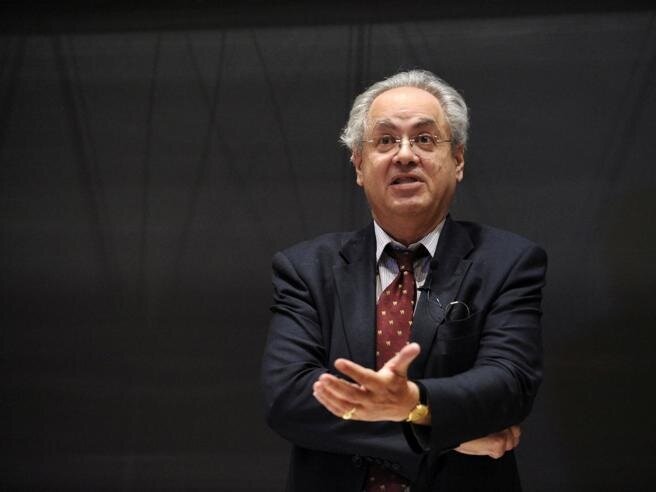
Abulafia dialoga coi suoi maestri e predecessori, fonda il suo pensiero sul lavoro di Fernand Braudel, insieme a lui rivendica l’identità umana ancor prima che geografica della storia del Mediterraneo, ricercando approfonditamente le cause e conseguenze sociali e economiche dettate dai vari fenomeni umani accorsi nei secoli.
Abulafia ci racconta di una mare che non divide ma unisce. Non vede una superficie intonsa ma una base instabile per strutture socio-culturali millenarie, uno spazio ibrido e comunicante che connette e non lascia il tempo di sedimentare che già si appresta a cambiare. Questa sua convinzione ripercorre tutti i contesti storici da lui studiati: dal Medioevo, alle città marinare, alla Sicilia di Federico II fino alla Spagna della Reconquista. Il Mediterraneo che troviamo, per esempio, nel suo “Il Grande mare. Storia del Mediterraneo” (Mondadori, 2013) (nella foto in basso) è un fitto intreccio di rapporti, dove identità, lingue e civiltà si toccano e si mescolano, trovando la loro definizione nello scambio non nella purezza. Quello che ci viene presentato è un mondo fatto di contaminazioni continue e costanti che rende vana ogni narrazione nazionale o monolitica.

Non è una casualità se Abulafia sembra così attento al racconto delle minoranze, delle diaspore e delle rotte mercantili. Già dalla sua stessa esperienza familiare, legata al mondo sefardita e al ricordo della cacciata dalla Spagna, possiamo comprendere la sua umana sensibilità per racconti di migrazioni forzate e di ricostruzioni identitarie. Nella sua visione di storico studia il Mediterraneo come un contesto fatto di movimento e pluralità. Quando poi scrive “The Boundless Sea: A Human History of the Oceans” (Feltrinelli, 2019), decidendo di trattare la storia marittima a livello mondiale, non sta tradendo il Mediterraneo, lo sta solo osservando da una prospettiva più grande. Dimostrando ancora una volta come è in questo mare che l’umanità si è per prima espressa e sia cresciuta fino a conquistare il mondo, qui dove furono mossi i primi passi su una superficie liquida, instabile e sconosciuta, qui l’uomo per la prima volta nella storia si è scoperto esploratore e sognatore.
Questo è ciò che ci ha lasciato David Abulafia: uno stupendo racconto fatto di uomini, ideali e mare. Un mare che non è mai stato di nessuno e che nessuno ha saputo ridurre a definizione costante, ma che possiamo solo scorgere in movimento, disegnato da scambi e condivisioni.
In un’attualità dove il Mediterraneo sembra essere solo descritto come confine e barriera, è giusto e doverosa la memoria di persone come David Abulafia che ci ricordano come prima di ogni cosa il mare è un luogo di possibilità.
Ernesto Ciampi per @europolitiche.it